Why Are People Still Moving to Miami? 3 Forces Shaping South Florida Real Estate in 2026
Population growth, tax policy and international buying power continue to influence Miami’s real estate market. Here’s what the latest data tells us about who is coming to Florida—and why.
Miami’s real estate market does not operate in a vacuum. Some of the most important forces affecting demand today are happening far beyond South Florida.
Ron Shuffield of Berkshire Hathaway HomeServices EWM Realty recently released his second-quarter market report, and four of the charts particularly caught my attention. Together, they help explain some of the forces that have fueled South Florida’s extraordinary growth in recent years: population shifts, taxes and international buying power.
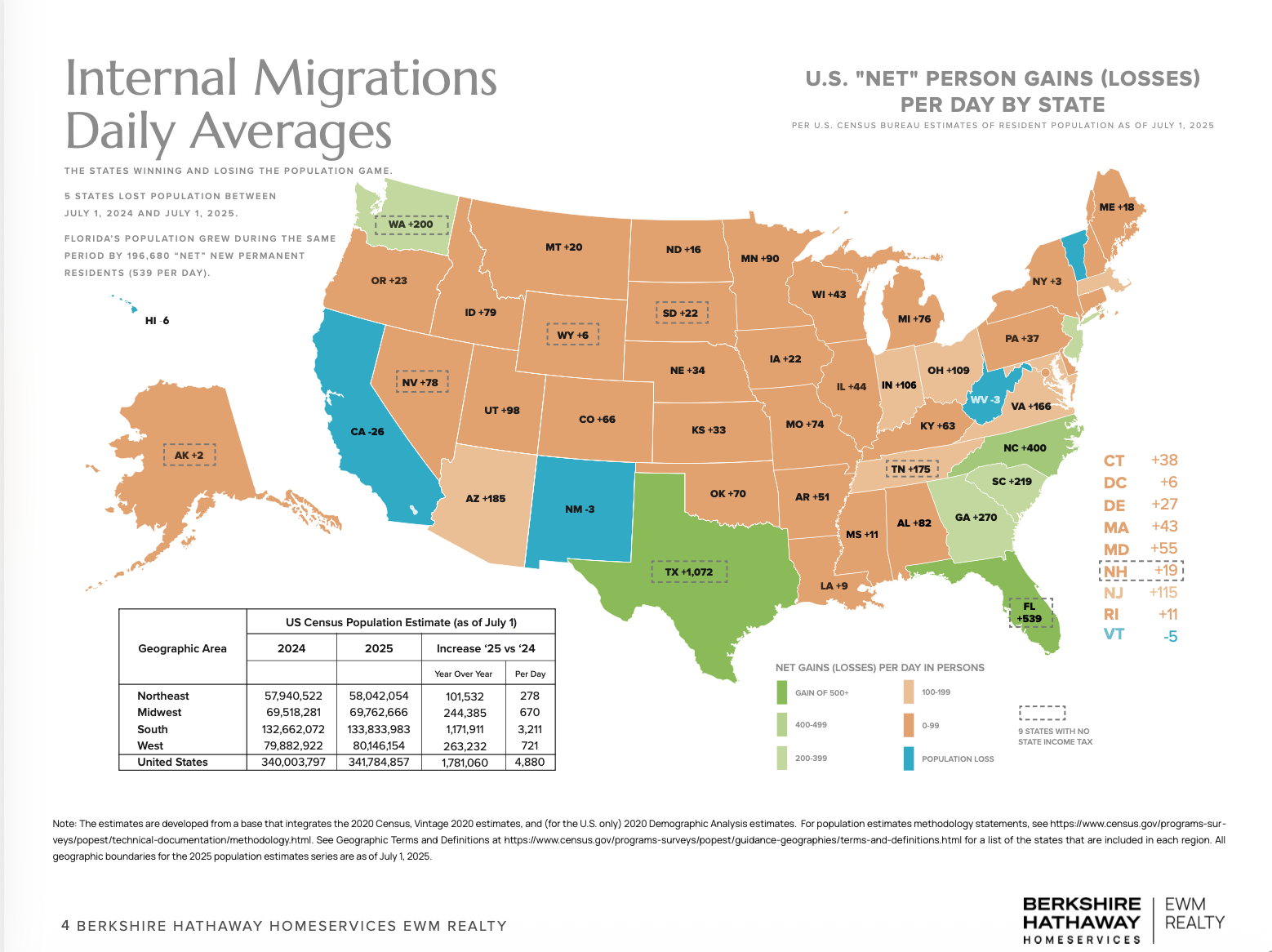
Florida Continues to Gain Residents
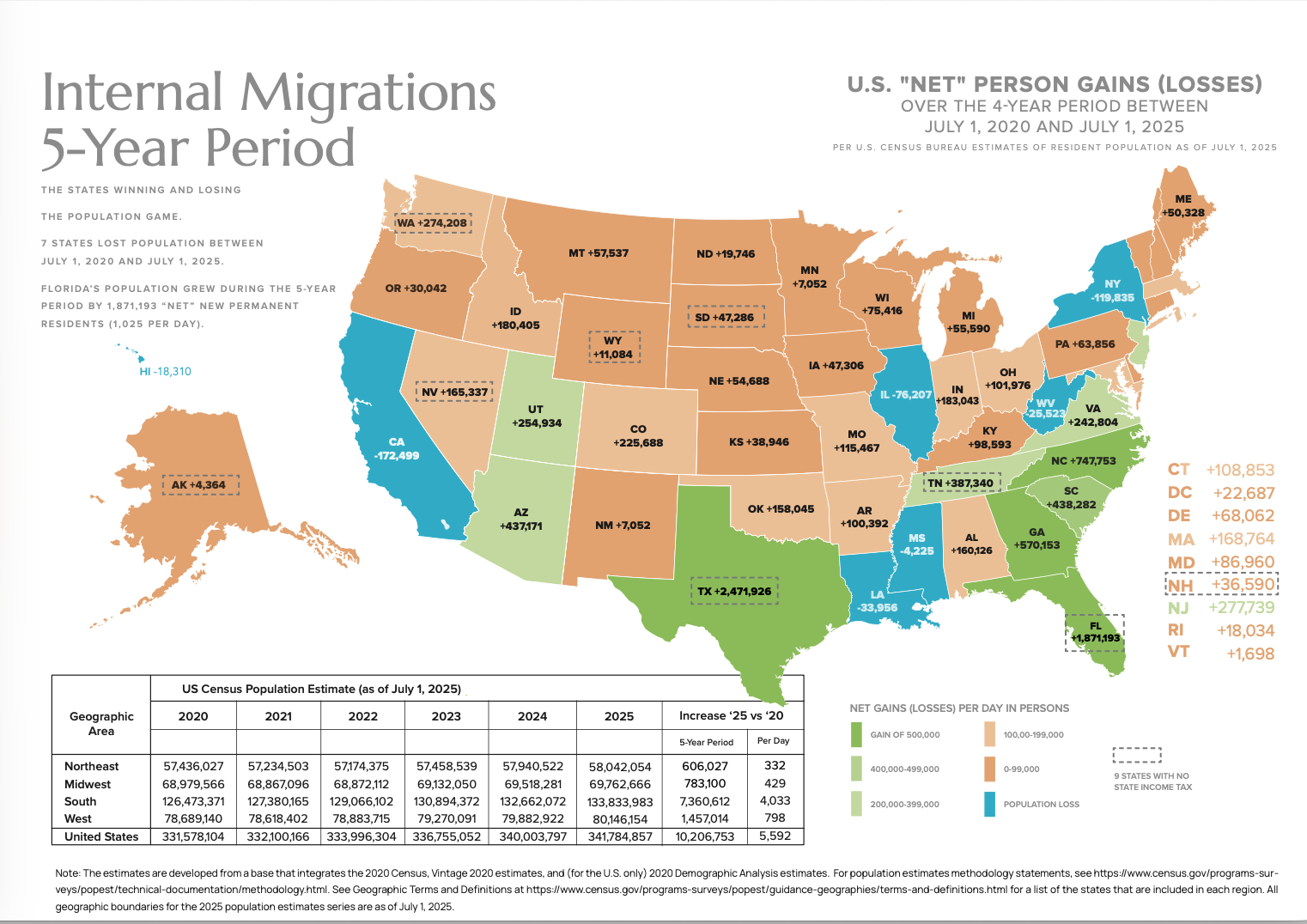
One of the clearest trends is continued population growth in Florida.
According to U.S. Census Bureau estimates, Florida added 196,680 residents between July 1, 2024 and July 1, 2025—approximately 539 people per day. Only Texas added more residents in absolute numbers during that period.
Over the longer five-year period highlighted in the EWM report, Florida gained approximately 1.87 million residents.
But there is an important shift happening within those numbers.
Florida has long been associated with domestic migration from states such as New York, New Jersey, Illinois and California. That remains part of the story, but international migration has become increasingly important. The Census Bureau estimates Florida received 178,674 net international migrants in the latest annual period, the highest number of any state.
For Miami, one of the most internationally connected cities in the country, that matters.
Currency Rates Can Change Who Has Buying Power in Miami
International buyers have always played an important role in Miami real estate, particularly in the luxury condominium and waterfront markets.
But their purchasing power can change dramatically based on currency movements.
The EWM report compares foreign currencies against the U.S. dollar from June 2025 to June 2026. For an Argentine buyer, the change in exchange rates effectively makes purchasing in U.S. dollars 24.5% more expensive. For a Colombian buyer, the shift goes in the opposite direction, making a dollar-denominated purchase approximately 15.7% less expensive.
Those differences are significant.
Currency movements do not tell us exactly who will buy Miami real estate next, but they can help us understand why demand from certain international markets strengthens while demand from others becomes more price-sensitive.
That is particularly relevant in Miami, where the buyer pool can change very quickly based on global economic conditions.
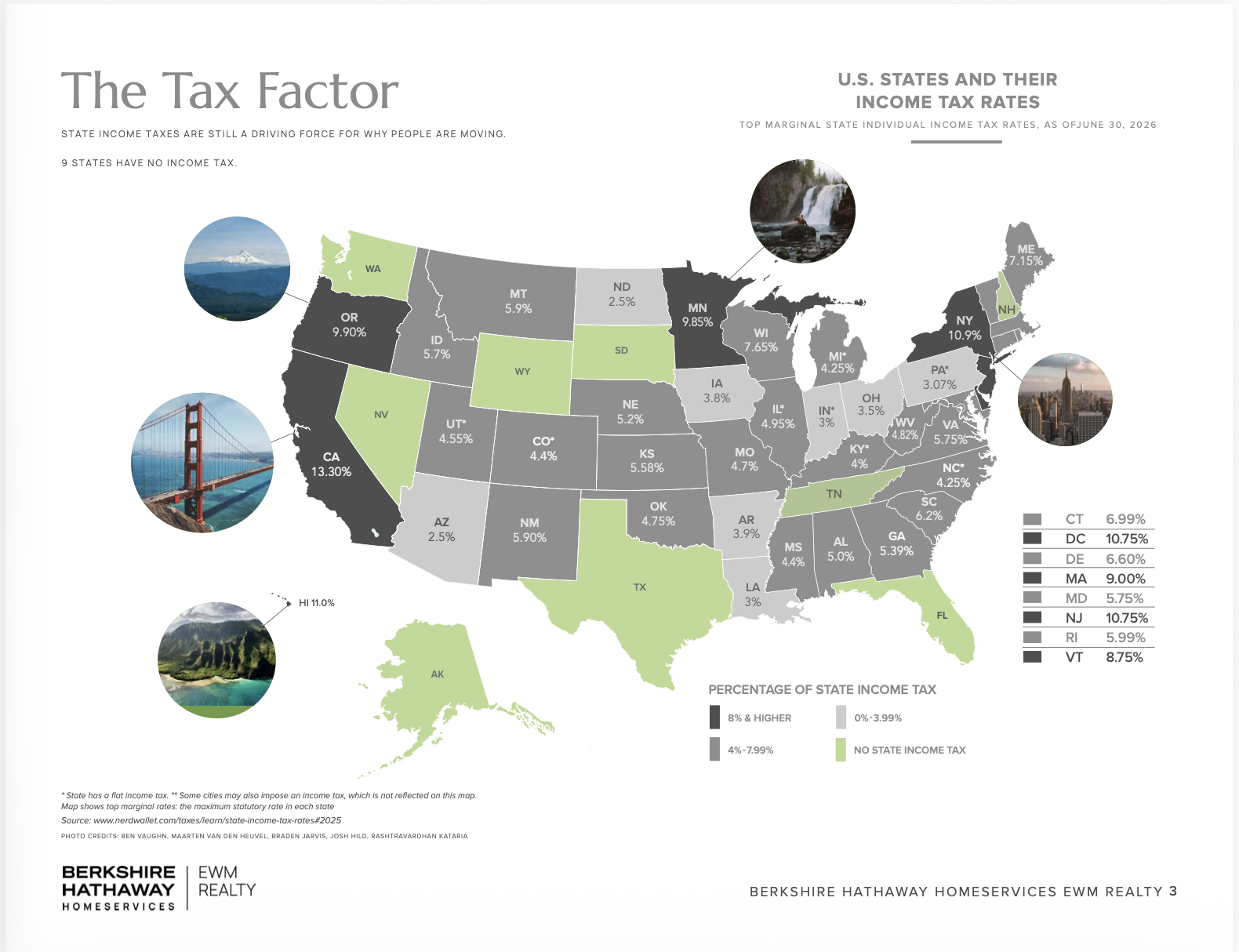
Florida's Tax Advantage Remains Powerful
Then there is the tax factor.
Florida does not impose a personal state income tax, an advantage that continues to distinguish it from many of the states from which affluent individuals and business owners relocate.
Tax policy is certainly not the only reason people move to Miami. Lifestyle, business opportunities, weather, schools, global connectivity and the quality of South Florida's residential communities all play a role.
But for high-net-worth and ultra-high-net-worth households, the difference between state tax structures can become meaningful.
California is an interesting example to watch in 2026. Voters there will consider Proposition 40 in November, which proposes a one-time 5% tax on the wealth of billionaires. It has not become law, but the proposal illustrates why state tax policy has increasingly become part of relocation conversations among wealthy families and business owners.
What Does This Mean for the Miami Real Estate Market?
The biggest takeaway is that Miami's demand is being shaped by much more than local real estate conditions.
Population movement, international currency fluctuations and state tax policies can all influence who is considering Miami, what they can afford and where they choose to purchase.
For buyers and sellers—particularly at the luxury level—understanding those larger trends is an increasingly important part of understanding the Miami market.
If you would like to talk about what these trends mean for your property, your neighborhood or a potential move to Miami, please reach out. I am always happy to share what we are seeing on the ground.
FAQ's
Frequently Asked Questions About Miami Real Estate and Relocation
Why are wealthy individuals and families moving to Miami?
High-net-worth individuals continue to be attracted to Miami for a combination of reasons, including Florida’s lack of a personal state income tax, favorable business climate, year-round lifestyle, international accessibility, private schools, and luxury housing options. Miami has also developed into an increasingly important financial, technology, and business center, making it attractive as both a primary residence and a strategic base.
Does Florida have a state income tax?
No. Florida does not impose a personal state income tax. For individuals relocating from higher-tax states such as New York, New Jersey or California, that difference can be significant, particularly for high-income households. Taxes are only one part of a relocation decision, but Florida’s tax structure continues to be an important factor influencing migration to Miami and South Florida.
Are international buyers still purchasing Miami real estate?
Yes. International buyers remain an important part of the Miami real estate market, particularly in luxury condominiums, waterfront properties and investment real estate. However, demand can vary considerably by country as currency exchange rates affect purchasing power. Miami’s global connectivity, lifestyle, relative political and economic stability, and long-established international community continue to make South Florida attractive to buyers from Latin America, Europe, Canada and beyond.
Ashley Cusack is a Senior Vice President at Berkshire Hathaway HomeServices EWM Realty, specializing in Miami's ultra-luxury waterfront market. She represented the 2022 sale of the Adrienne Arsht Estate — Miami-Dade County's first residential transaction to exceed $100million — and currently holds the exclusive listing for 3149 Brickell Avenue, Coconut Grove, offered at $110,000,000.

Ashley Cusack is a distinguished Senior Vice President at Berkshire Hathaway HomeServices EWM Realty, with a notable tenure in Miami's luxury real estate market.
With nearly three decades of experience, she has established herself as a leading expert in residential and waterfront properties. As a testament to her success, she has been recognized as a top producer within her brokerage, with sales volume over $1.3 billion, placing her in the top echelon of realtors nationwide. In 2022, Ashley sold the “Arsht Estate,” Miami’s only residential sale over $100M to date.
Don't hesitate to reach out to me, Ashley Cusack at {305.798.8685, email and website}. Senior Vice President, Berkshire Hathaway HomeServices EWM Realty.